Vancouver Island’s western edge, without rushing the drive
Vancouver Island is large enough to reward a regional rather than island-wide itinerary. A west-coast stay can combine rainforest walks, long beaches and the practical rhythm of a small coastal town.
Inside this story
Vancouver Island's Pacific coast deserves a stay of its own. Treating Tofino as a quick excursion from Victoria compresses a substantial journey into the margins of an already full day, leaving little attention for the forest and shore that justify coming west. A better plan arrives, settles and learns the nearest safe places to walk before attempting anything ambitious. Tofino, Ucluelet and the Long Beach area can then form a coherent coastal stay. Rainforest, ocean and small-town life remain distinct experiences within it, each calling for a different assessment of conditions rather than a single assumption that everything outdoors belongs in the same day's program.
- Victoria and the Pacific Rim coast are separate itinerary regions.
- Storm watching requires safe public viewpoints well back from waves and logs.
- A wet-weather day can still be rewarding without entering exposed coastal trails.
Arrive before asking the coast to entertain you
The drive toward Tofino and Ucluelet requires its own time and current road checks. Examine the whole route from the previous night's accommodation, including ferry arrangements if relevant, meal stops and the final approach. Do not promise a fixed excursion immediately after a journey whose timing has several moving parts. A comfortable arrival with time to find food and unpack rainwear is already a useful first afternoon.
Choose the accommodation by the part of the coast you expect to use most often. Staying convenient to one town can simplify meals and reduce repeated driving, while a more isolated property may suit someone seeking a settled retreat. Ask about the actual walking route to nearby services; a short road distance does not guarantee an appropriate pedestrian connection. If arriving without a car, confirm every stage rather than assuming that a regional arrival includes a last connection to the room. The base should support wet clothing, changing plans and ordinary meals as well as the ideal clear-weather outing. Those practical details become particularly valuable after a long drive or an afternoon when the rain does not stop.
Let Tofino introduce a working coast
Tofino can anchor the stay through meals, supplies and short public walks, rather than functioning only as the name attached to a beach holiday. Spend time understanding its scale and where ordinary services are located. A quiet first circuit helps separate the places you can revisit casually from outings needing transport or advance arrangements. Keep harbor areas and business entrances clear, especially when stopping to consult a map or organize a group photograph.
The town's relationship with the water is not exclusively recreational. Observe activity from permitted public places without entering working areas or assuming that every waterfront structure welcomes visitors. Ask before making close photographs of people. A seated meal offers a useful pause after arrival and a chance to plan the next morning with a clearer sense of conditions. It is tempting to treat town time as something to squeeze between more authentic natural experiences, but it provides the human framework that makes the coast usable. Learning where to eat, refill supplies and obtain current advice allows later days outside to feel spacious rather than operationally fragile.
A rainforest walk rewards the downward glance
In the Long Beach Unit of Pacific Rim National Park Reserve, rainforest trails reveal a different scale from the ocean. Tall trees attract the first look, but roots, fallen wood, water and the layered vegetation below them deserve equal attention. Parks Canada's trail descriptions identify western red cedar and western hemlock among the trees encountered on the Rainforest Trail. Use that interpretation as an invitation to observe, rather than expecting to identify everything immediately: parks.canada.ca.
A boardwalk is still a walking surface that requires assessment. Wet timber can be slippery, and stairs or changes in width may affect suitability. Read the individual route description and current conditions, particularly if anyone needs step-free access. A short trail is not automatically an accessible one. Move slowly enough to maintain footing and leave space for people coming the other way. Rain can make the forest especially absorbing, but appropriate clothing and a willingness to shorten the outing remain important. This is a place where distance is a poor measure of experience: a careful look at one decaying log can reveal more about forest processes than completing another loop while concentrating only on the exit.
Within the forest, look for the distinction between a standing tree and the habitat created as wood falls and decays. The canopy, understory and forest floor operate at different scales, which makes even a brief pause rewarding. Parks Canada presents the Rainforest Trail as an opportunity to attend to that living structure, not only the largest trunks. Use the designated path to observe it without trampling the vegetation beneath the boardwalk.
Keep the ocean at a respectful distance
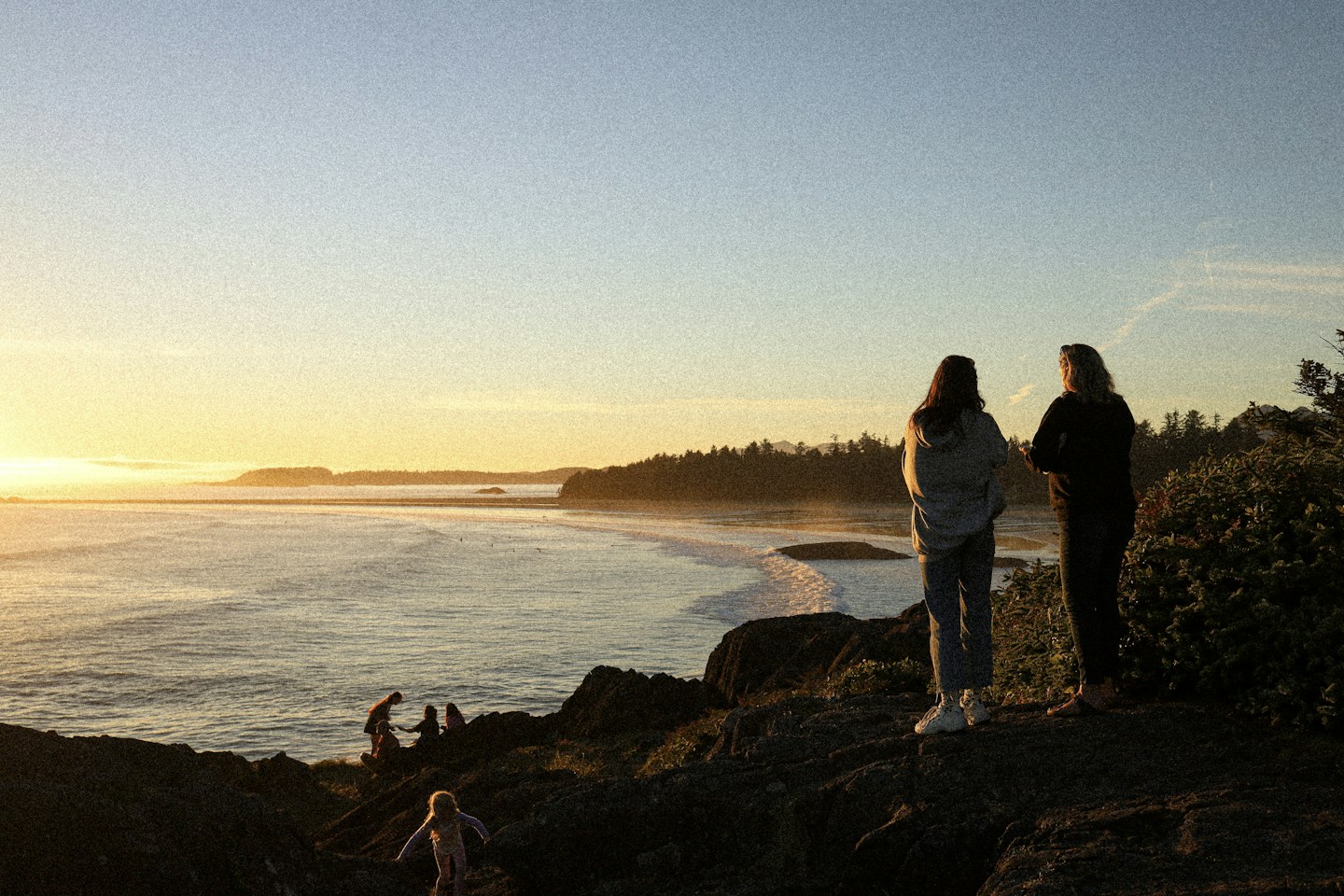
Pacific beaches present broad views but also powerful surf and changing conditions. Choose established public access and follow current guidance. The apparent openness of a beach should not be confused with permission to approach every wave or climb on every log. Moving water can shift heavy debris, and a dramatic storm is best observed from a safe designated position well away from waves and logs.
Do not plan storm watching as a challenge to get as close as possible. The experience is the scale and movement of the coast, which can be appreciated from a protected location. If conditions make that location unsuitable, change the activity. Children need close supervision, and photography should not leave anyone facing away from an approaching hazard. Likewise, an attractive beach does not establish safe swimming or surfing. Anyone considering a water activity should seek qualified local instruction and appropriate equipment for the actual conditions. A shore walk and a lesson on the water are different undertakings; each deserves its own assessment rather than confidence transferred from one to the other.
Read the tide pools without taking possession
An intertidal outing can be one of the stay's most absorbing quiet experiences, provided its timing and access are understood. Obtain current tide information and local advice for the specific place, then remain aware of the return route. Water levels and surf can affect how safely you can move along the shore. Avoid exploring farther simply because a chain of exposed rocks appears to lead onward.
Observe marine life where it belongs. Do not pry, collect or rearrange creatures for a photograph, and be careful where you place hands and feet. A living shore is not a tray of objects available for handling. Stay within appropriate public access and follow protected-area rules. For families, a few carefully observed pools can be more engaging than a long scramble that eventually requires hurrying back. Let questions guide the visit: what remains submerged, what occupies a shaded crevice and what changes as water moves? You do not need a complete species list to recognize the shore as a demanding habitat. Patience and restraint make it possible to learn without altering the scene for the next visitor.
Seek cultural interpretation from its proper source
The Pacific Rim coast is within Indigenous homelands, and a visit should not present its forests and shores as empty wilderness with no human history. Parks Canada identifies the Long Beach setting with Nuu-chah-nulth peoples. For deeper understanding, seek community-led resources and experiences that explain their own territories, histories and contemporary life. A place name or a brief interpretive sign can be a starting point, but it is not permission to speak for a community.
When considering a guided cultural visit, read how it is described and who provides it. Ask practical questions about participation, photography and access, then follow the host's guidance. Avoid treating stories, designs or ceremonial references as decorative themes detached from their owners and meaning. Contemporary presence matters as much as historical interpretation: communities continue to make decisions about land, business and cultural expression. Giving this dimension time can change how you understand an otherwise familiar rainforest walk. The landscape becomes a place of relationships and responsibility, rather than merely a natural backdrop whose human story begins when a visitor arrives with a camera.
Choose one specialist outing and leave it room
Boat trips, wildlife viewing and paddling can require advance arrangements, but a reservation should be placed in a day with enough breathing space. Ask the operator about conditions, equipment, group suitability and the approach to wildlife. Animals should be observed without feeding, crowding or pursuit. Protected-area rules on distance and food storage need to be followed even when the animal appears accustomed to people.
Keep another possible date open if the activity is especially important, while accepting that weather may prevent it entirely. Do not fill the cancellation with an equally exposed self-directed outing simply to preserve the day's adventurous character. A forest walk of suitable length, a cultural visit or town time may offer a better response. When arranging several activities, account for rest and drying equipment between them. Continually moving from wet excursion to wet excursion can leave the group less prepared and less attentive. One well-chosen specialist experience, understood and allowed to occupy its own day, often contributes more than a collection of tightly scheduled departures.
End with a local walk, then a deliberate departure
On the last full day, revisit a convenient public shore or forest route under suitable conditions. Familiarity lets you notice what has changed: light through the canopy, the extent of exposed sand or the strength of the wind. This is a convincing reason to stay several nights. The coast becomes recognizable rather than remaining a sequence of first impressions collected between drives.
Use tourismvancouverisland.com for regional orientation and the responsible park and road authorities for current access and conditions. Plan departure from the west coast as a substantial journey, particularly if a ferry or flight follows. Avoid attaching an unplanned distant beach stop to the same morning merely because it remains unseen. The reward of this visit is depth within one region: Tofino understood as a town, forest experienced at close range and the Pacific observed with appropriate distance. Leaving with energy and time for the journey home preserves that experience far better than extending the itinerary until the last possible hour.
A few practical questions
Is a rainforest boardwalk necessarily accessible?
No. Check the individual trail for steps, width, surface and current conditions. Short distance or a boardwalk description alone does not establish suitability.
Can Victoria and Tofino be treated as one small region?
They serve different parts of the island. Give the west-coast journey and stay their own time, especially when onward transport has a fixed departure.
For current destination information, access guidance and local updates, visit the official Vancouver Island travel resource. Check transport and attraction details directly before booking.
This is a general planning guide, not a live conditions report. Found something that needs updating? Send a correction.