Fez: a thoughtful first visit to the medina
Fez deserves more than a fast walk behind a guide. Start with the medina’s working geography, make space for craft traditions and choose pauses that allow the city’s layers to become legible.
Inside this story
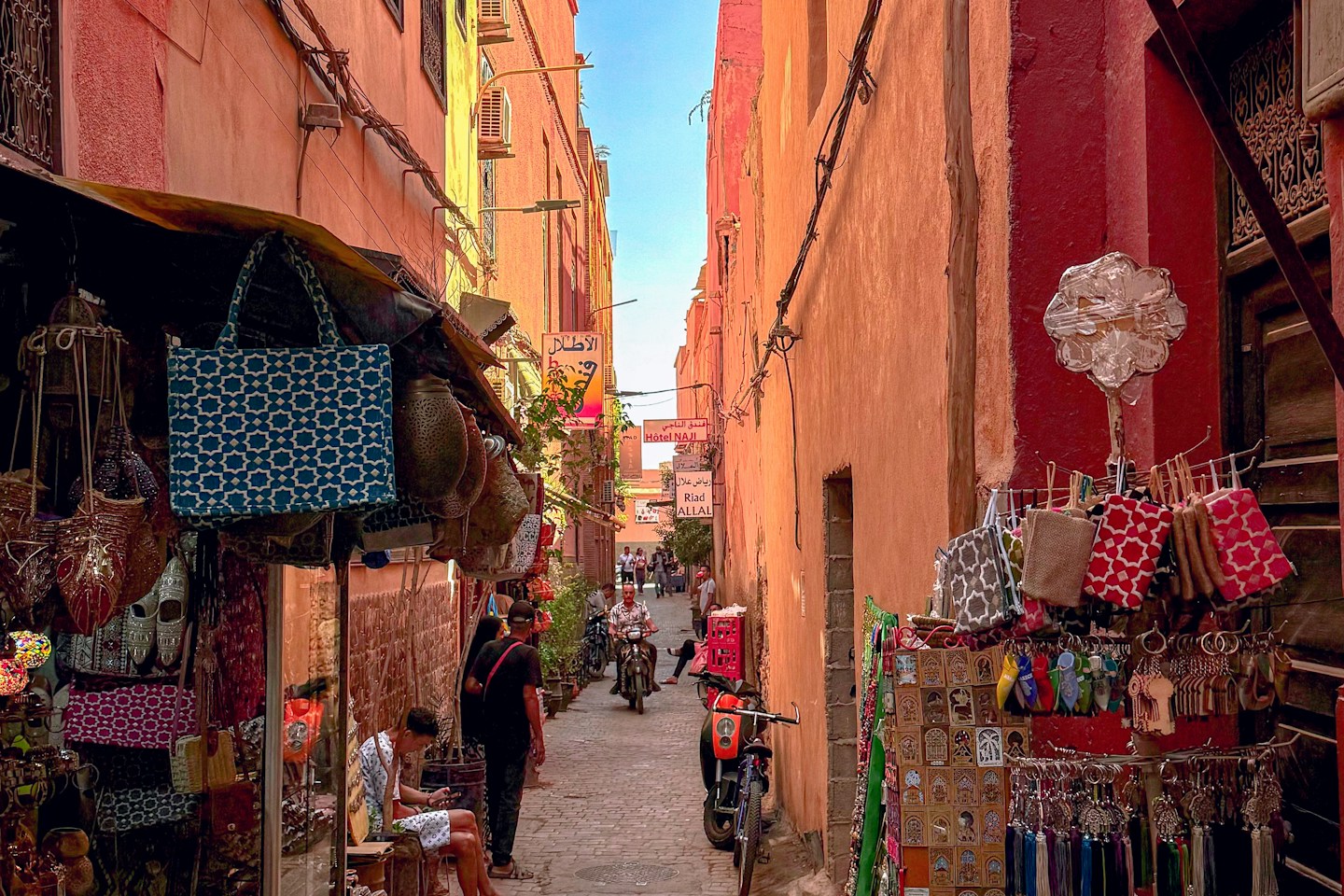
A first visit to Fez can be intensely immediate: lanes narrow, goods occupy shopfronts, and navigation competes with the wish to understand what is happening around you. The medina makes more sense when it is treated as a working urban environment rather than a maze designed for visitors. Commerce, homes, worship and craft coexist within the same streets. Finding a route is useful; learning what the route connects is the more interesting task.
Give the visit an intelligible beginning and a quiet ending. Arrange the arrival, choose a reliable meeting point and decide which subjects merit explanation. A guided walk focused on craft or architecture can establish a framework, while an independent return to a familiar area can deepen it. There is no need to turn disorientation into a test of authenticity or to treat every invitation as part of the itinerary.
- The medina contains an intricate network of lanes used for everyday commerce.
- Tannery viewpoints can be associated with shops and sales conversations.
- A prearranged accommodation arrival reduces pressure when carrying luggage through unfamiliar streets.
Arrival should happen before exploration
An accommodation address does not always describe a vehicle-accessible doorstep. Before arriving with luggage, ask where a taxi can stop, how the final approach works and whether assistance is available. Keep the meeting instructions and contact details accessible offline. Establish the arrangement with the accommodation itself rather than relying on someone who offers to take over after you arrive. Knowing the final few minutes of the journey makes the first encounter with unfamiliar lanes considerably calmer.
Once settled, begin with a small public circuit that can be reversed. Note a clear meeting point and the approach to accommodation, but do not depend on one shop remaining open as the only landmark. A photograph of a junction can help if taken without intruding on people. The goal is not to master the entire medina on the first afternoon. It is to gain enough familiarity that the following day can focus on history, craft and food instead of repeatedly resolving the question of how to return.
A guide should provide a subject as well as a route
Navigation and interpretation are separate services. Before engaging a guide, discuss which you need and what the visit will cover. An architecture-focused walk may differ substantially from a craft itinerary or a general introduction. Ask about language, duration, pace and the handling of shopping stops. A clear agreement allows both visitor and guide to spend time on the intended experience rather than discovering incompatible expectations halfway through the morning.
Use an appropriately licensed guide and confirm arrangements through a reliable channel. This does not mean surrendering your interests once the walk begins. Ask questions that invite explanation: what a building was used for, how a craft process changes an object or why a particular activity clusters in one area. If an answer is uncertain, a careful guide should be able to acknowledge that. A confident narrative is not automatically a well-supported one, and the city deserves more than anecdotes selected only because they sound memorable.
Read lanes through the activity they support
A narrow street can contain more order than a visitor first recognizes. Goods, tools and repeated types of shop may indicate a commercial concentration, while a quieter turn may lead toward residential space. Observe these changes without assuming every lane exists for browsing. Deliveries and people carrying out ordinary errands need room. Step into a suitable stopping place before opening a map or gathering companions for a discussion.
Footwear and carrying choices affect how much attention remains available. Uneven ground and steps make an apparently short route demanding, especially when the group stops and starts frequently. Keep hands reasonably free and bags compact. If someone becomes tired, find a proper seated pause rather than extending the walk because the next attraction is said to be close. In a dense historic district, the final distance can contain more changes of direction and level than the estimate suggests.
Craft visits need permission and a clear exchange
A workshop is first a place where work is done. Before entering, establish whether visits are welcome and whether a demonstration, explanation or purchase is expected. Ask permission before photographing people or detailed processes. An artisan may be happy to answer a concise question but unable to interrupt a time-sensitive task. Respecting that distinction makes the encounter more informative than treating every bench as an exhibit with an attendant.
Look at the sequence between material and finished object. Which stages are visible? Which happen elsewhere? What features distinguish handwork from an item assembled or finished on site? These questions can be asked courteously without assuming dishonesty or demanding proof of every sales claim. If considering a purchase, examine the object itself and discuss care, transport and documentation. Understanding an item's making is valuable, but an engaging demonstration does not remove the need to decide whether the actual object suits your budget and use.
Tannery viewpoints come with commercial context
A tannery view is often reached through a shop or commercial premises. Understand that arrangement before going upstairs: is there a fee, an expectation of browsing or simply an invitation with no purchase required? Clarifying the exchange is easier at the beginning than after an extended sales conversation. A view can be interesting without obliging a visitor to buy leather goods, and declining should remain polite and unambiguous.
The visual scene also needs interpretation. Ask what can actually be observed from the viewpoint and which processes are being explained. Avoid repeating detailed claims about substances or working practices unless they are supported by a reliable account. Workers are people engaged in demanding labor, not small figures included to improve a composition. A distant view does not require close photography, and an elevated vantage point should not remove ordinary respect for privacy. Give the process more attention than the pursuit of an identical image to one already seen online.
Religious architecture has particular access rules
The Bou Inania madrasa gives architectural curiosity a particular focus. Its cedar woodwork and carved plaster offer different materials and techniques to compare, so a visit can move beyond a general impression of elaborate decoration. Check the current permitted visitor areas and respect any worship or restricted space within the complex; a cultural entrance does not authorize access to every room. The Nejjarine Museum of Wooden Arts and Crafts offers another useful connection between buildings and making, occupying a former commercial fondouk. Together, these examples can help distinguish religious education, trade and craftsmanship without treating the medina as one undifferentiated historical scene.
Do not assume that all historic religious buildings share the same visitor policy. An institution open for cultural visits may operate differently from an active worship space, and permitted areas can vary. Check the individual site's instructions and follow them at the entrance. Dress and conduct should reflect the setting. A closed threshold is a boundary to respect rather than a puzzle to solve through a side door or the encouragement of an unofficial escort.
Where entry is possible, allow time for proportion, materials and decoration to register. One interior observed patiently can provide a better understanding than several entered in rapid succession. Ask what is original, what has been restored and how the space was used, relying on available interpretation rather than visual guesses. If entry is unavailable, a guide can still explain the building from public space. An informed exterior visit is worthwhile and should not be described as a failed version of an experience that was never open to the visitor.
Homes remain homes behind attractive doors
A decorated entrance does not establish a public attraction. Residential courtyards and doors deserve the same restraint that a visitor would expect outside their own home. Photograph architecture from an appropriate public position without leaning through openings or including people unexpectedly. If a resident offers access, clarify what is welcome rather than treating one invitation as permission to explore every adjoining space.
The distinction matters in quieter lanes where visitors may be especially noticeable. Keep voices down, avoid gathering a large group in front of a doorway and move on when the space is needed. These behaviors do not diminish curiosity; they direct it toward what can be understood responsibly. The medina's domestic life is part of its meaning precisely because it continues beyond the visitor's route. A good account of the city can acknowledge that continuing life without claiming unrestricted visual access to it.
Let food offer a change in tempo
A meal should provide a real change from the intensity of walking and bargaining. Choose a place with a menu and price arrangement you understand, and ask about ingredients if dietary needs require it. A short translation can omit the contents of a sauce or stock, so explain the need directly. If ordering for several people, check portions and whether dishes are intended to be shared before building an unnecessarily large table.
Keep the lunch location compatible with the morning's endpoint. The promise of an exceptional restaurant is less useful when reaching it requires another difficult navigation exercise after the group is tired. A seated pause can also help organize impressions. Discuss which process or building raised a question, then decide whether the afternoon should answer it or offer a different setting. The best continuation may be a museum or garden rather than a second dense circuit through commercial lanes.
A quieter afternoon makes the medina more legible
A garden, collection or other calmer public setting can give the morning's impressions room to settle. Check current access and transport rather than assuming that a green area shown on a map is freely enterable. Choose one place with enough time to remain there. The change of sensory pace matters: it allows individual materials, explanations and encounters to become distinct instead of blending into a general memory of bustle.
On another morning, return to a small area whose geography is now familiar. Without constant navigation, you can notice differences in trade and street use, or ask a follow-up question at a welcoming shop. This is where an initial guided framework becomes useful independent knowledge. Fez does not need to become fully comprehensible during a short stay. A successful visit leaves the traveler with a few accurate relationships, greater respect for the work happening there and a clear sense of which questions deserve another visit.
A few practical questions
Is independent wandering the best way to begin?
It can suit confident travelers, but a well-arranged introduction may make both geography and interpretation clearer. Establish a reliable return route first, then explore a manageable public area rather than using disorientation as the measure of a successful visit.
Does a workshop demonstration require a purchase?
Clarify expectations before the visit. A demonstration may be paid, included in a guided arrangement or offered by a shop hoping to sell. Understand the terms, ask reasonable questions and buy only when the item and price make sense.
For current destination information, access guidance and local updates, visit the official Fez travel resource. Check transport and attraction details directly before booking.
This is a general planning guide, not a live conditions report. Found something that needs updating? Send a correction.